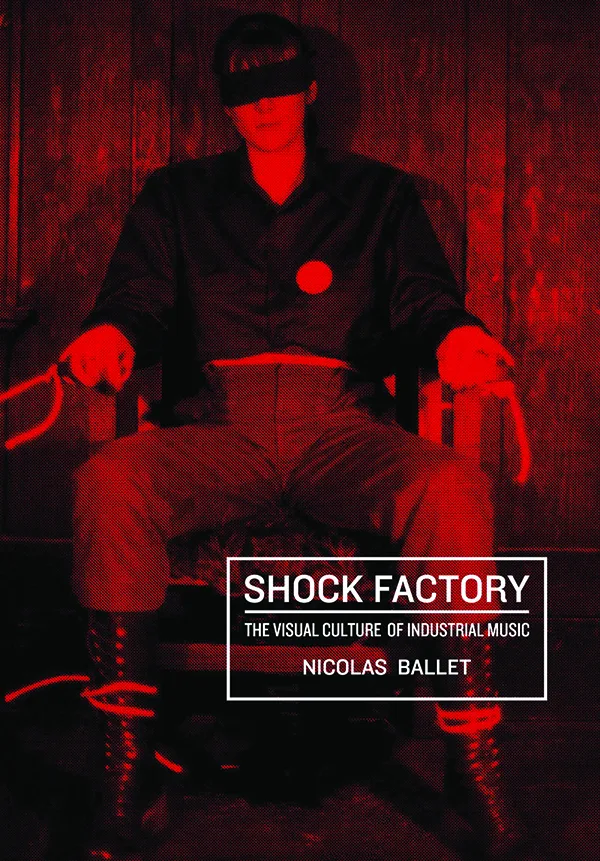
Nicolas Ballet’sShock Factoryis a monumental undertaking – a 500-page scholarly exploration of industrial music, a genre born from dissonance and defiance. It’s a surprising pairing: meticulous academic rigor applied to a world deliberately constructed on noise, transgression, and the rejection of convention. Ballet spent years immersed in this sonic and visual counterculture, conducting interviews dating back to 2014 and meticulously assembling a vast archive of manifestos, collages, and unsettling recordings.
The book attempts to chart the origins of a movement that proved notoriously difficult to define. While every underground scene has a genesis for its participants and another for the wider world, industrial music’s dual beginnings are shrouded in obscurity. For some, it evokes memories of the early 1990s, a shift from flannel and grunge to mesh and the stark precision of German electronic music. But this period also carries a darker association, tragically linked to a wave of school violence, a connection that casts a long shadow.
Ballet deliberately focuses on the movement’s formative years, from the mid-1970s to 1995, primarily in the UK and Europe. He stops short of examining its mainstream success and, crucially, its transformation in the digital age. This limitation suggests a belief that industrial music, in its purest analog form, is primarily a historical artifact – a frozen moment in time, unlike the constantly evolving energy of punk. However, its legacy proves far more complex than a simple historical footnote.
Like punk, industrial music didn’t emerge in a vacuum. It was a reaction *to* the previous counterculture, but unlike punk’s outright rejection of psychedelia, industrial was a reflection of it. Both shared a desire for multimedia sensory overload, a fascination with sonic manipulation, but where psychedelia aimed to “kiss the sky,” industrial plunged into the “cosmic abyss.” Throbbing Gristle’s 1977 track “Hamburger Lady” perfectly encapsulates this – a disturbing aural diorama recounting a burn victim’s story through distorted vocals and unsettling soundscapes, a work that makes even Radiohead sound conventional.
Ballet’s analysis mirrors this duality. Industrial artists, many with roots in the 1960s underground, drew inspiration from fringe spirituality, Cold War anxieties, consumerism, and sexual liberation – but each concept was twisted and inverted. Utopian ideals became dystopian confrontations, aesthetics borrowed from fascism, and performances embraced taboo subjects like self-harm and blasphemy. Bands actively sought to provoke, to “wind society up,” as Cabaret Voltaire’s Richard H. Kirk put it, waging a sonic war on the status quo.
This rebellious spirit found intellectual grounding in the work of William S. Burroughs, whose experimental novels and theories of the “Electronic Revolution” served as a blueprint for the movement. Burroughs wasn’t merely a patron saint of excess, but a prophet whose ideas resonated deeply with industrial’s core tenets. His influence extended to film, notably the 1984 West German productionDecoder, which featured industrial artists and explored the potential of noise to disrupt society.
However,Shock Factoryoccasionally stumbles in its attempt to fully contextualize the movement. The sheer volume of documented material, while impressive, sometimes overshadows deeper analysis. A desire for ideological clarity leads to a reluctance to fully explore potentially problematic aspects, such as the appropriation of fascist imagery. The book also tends to overlook the movement’s complex relationship with pornography and its often-contradictory impact on gender dynamics.
Ultimately, the book reveals a generational blind spot: the tendency to always position oneself as the opposition. Ballet concludes by noting a resurgence of industrial sounds in contemporary pop music, framing it as a continuation of the struggle. But the irony is that industrial music, in many ways, *won*. We now live in an era defined by glitches, information overload, and a desensitized culture where nothing truly shocks. Noise dominates the 21st century, and the conditions that fostered 20th-century subcultures have largely vanished.
The spirit of rebellion, however, may simply find new expression. If the urge for disruption persists, a new generation might turn to a different text, one with “industrial” in its title, authored by a figure like Theodore Kaczynski, and embark on a new path of radical opposition.


