A chilling discovery unfolds midway through the series, a moment that would surely delight any editor. Aggie Wiggs, the journalist profiling Nile Jarvis, finds him not stealing, but meticulously documenting his own story. He’s essentially writing her article *for* her, transforming a potential “4” into a compelling “9” or “10.”
This isn’t simply a story about writing; it’s about manipulation. Nile, a man shadowed by suspicion in his wife’s disappearance, repeatedly elevates Aggie’s work, subtly steering the narrative. Initially struggling with a tribute to legal icons, Aggie is quickly drawn into Nile’s orbit, realizing his story holds far more dramatic weight.
Nile craves “relegitimization,” desperately needing a favorable portrayal as he pursues a massive development project. Aggie, haunted by personal tragedy – the loss of her son – sees this as a potential path back from professional and emotional ruin. Both are driven by deeply flawed, almost tawdry, motivations.
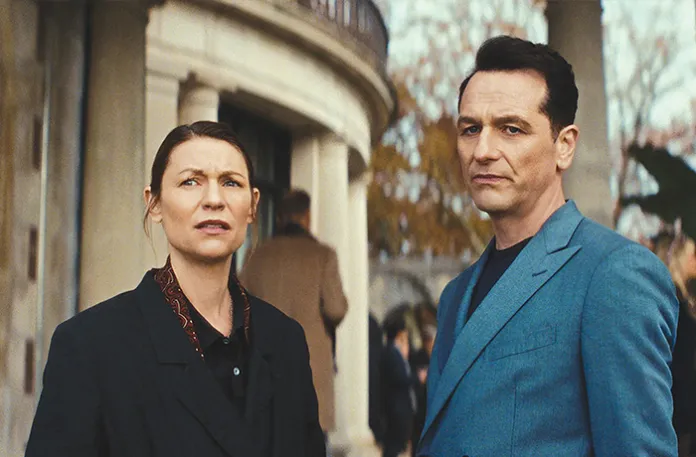
Matthew Rhys delivers a captivating performance as Nile, radiating a menacing charm that borders on unsettling. Having previously embodied a KGB officer in deep cover, Rhys now portrays a different kind of hidden figure, one who appears guilty, yet subtly questions that very perception. Is he truly a villain, or simply playing the part too well?
The supporting cast shines with equally compelling performances. Brittany Snow embodies a quiet charisma as Nile’s current wife, while Jonathan Banks delivers a nuanced portrayal of a father grappling with a troubled conscience. But it’s Deirdre O’Connell as Aggie’s agent who truly steals the show, a brilliantly observed character that feels instantly, and painfully, familiar.
Claire Danes, an actress renowned for her emotional depth, unfortunately falters in this role. While possessing exceptional technical skill, her signature mannerisms – the precise control of her facial muscles – have become predictable, losing their impact. A once-subtle quiver of the chin now appears regardless of the emotional context.
This lack of modulation creates a disconnect, particularly when paired with Rhys’s naturalistic performance. Where he inhabits the character, Danes often feels as though she’s performing *for* an audience, overshadowing the intimacy of the scenes. It’s a surprising turn for an actress who once defined teen angst and delivered a career-defining performance in a groundbreaking espionage thriller.
Despite this central performance issue, the series remains undeniably engaging. It’s a deliciously flawed spectacle, a captivating drama fueled by a compelling premise and a charismatic villain. It’s a story about power, manipulation, and the dangerous allure of a captivating narrative.
Ultimately, the series offers a guilty pleasure: watching a powerful man navigate scandal and build his empire while those around him struggle in his wake. It’s a captivating, if imperfect, exploration of ambition, grief, and the stories we tell ourselves to survive.


