Gus Van Sant’s latest film,Dead Man’s Wire, enters a fascinating, if unsettling, cinematic territory: stories of individuals pushed to the brink, broadcasting their desperation on live television. It echoes the raw energy of classics likeDog Day AfternoonandNetwork, films where characters teetered on the edge of sanity and publicly defied the established order.
However, where those earlier films offered a critical lens, a stark examination of societal pressures,Dead Man’s Wiretakes a different path. It doesn’t dissect the madness; it seems to embrace it, tilting towards a portrayal of its protagonist as a modern folk hero. The film centers on Tony Kiritsis, a man who, in 1977 Indianapolis, enacted a bizarre and terrifying act of protest.
Kiritsis didn’t simply protest; he kidnapped a mortgage company official, securing a sawed-off shotgun to a wire looped around the victim’s neck. The ensuing standoff culminated in a surreal press conference, a moment of televised chaos that captivated the nation. It’s a story ripe for dramatic exploration, yet the film struggles to balance the inherent drama with a sympathetic portrayal of Kiritsis’s motives.
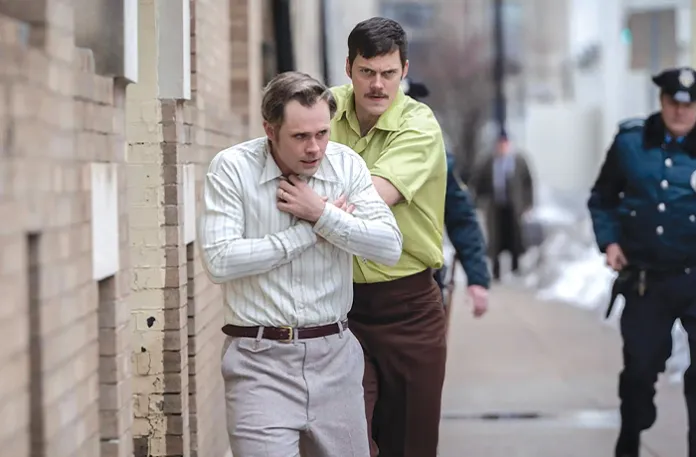
Bill Skarsgård embodies Tony, but departs significantly from the real man’s appearance. Kiritsis was a stocky, rough-hewn figure, while Skarsgård brings a lanky, almost ethereal quality to the role, reminiscent of Michael Shannon’s more subdued performances. Initially, this contrast works to the film’s advantage, presenting Tony not as a fiery revolutionary, but as an oddly naive and stumbling figure.
The film’s early scenes are darkly comedic as Tony awkwardly attempts to confront M.L. Hall, the head of Meridian Mortgage, only to find him on vacation. He’s forced to deal with Hall’s son, Dick, and unleashes a torrent of populist rhetoric, railing against a system he believes has deliberately undermined his business venture. He claims, “They set you up to try to take everything you got,” a sentiment the film presents without any discernible skepticism.
Tony’s method of making his point is undeniably extreme: holding Dick hostage with a device that threatens immediate, fatal consequences with the slightest movement. While Skarsgård delivers his impassioned speeches, Dacre Montgomery, as Dick, is largely confined to a state of terrified immobility. Yet, Van Sant manages to extract humor from the absurdity of the situation, populated by a colorful cast of bewildered onlookers.
A detective, recognizing the ingenious danger of Tony’s contraption, simply orders his officers to holster their weapons. A priest attempts to reason with Tony, only to be met with the dry retort, “It’s Tuesday, not Sunday, Father.” Tony remains unnervingly calm throughout, even compelling Dick to drive a stolen police car to his apartment, a location riddled with booby traps.
There are moments of genuine wit, like Tony’s fumbling attempt to address his pursuers over the police car’s loudspeaker, accidentally triggering a cacophony of sirens. The film also subtly echoes Van Sant’s earlier work, particularlyTo Die For, through the portrayal of a local news reporter who delivers a blunt, matter-of-fact account of the unfolding events: “It looked like a white guy strapped a shotgun to another white guy’s head.”
However, the film’s comedic momentum falters as the standoff intensifies. This isn’t due to a lack of tension, but rather a persistent inclination to portray Tony as a victim of circumstance, genuinely wronged by Meridian Mortgage. The film’s sympathy is further underscored by a trivializing depiction of M.L. Hall, shown obsessing over the improper preparation of a burrito.
The film never truly distances itself from Tony’s grievances, accepting his pronouncements at face value. We’re presented with a sob story of past hardships – selling ice cream, working as a used car salesman – while Dick endures indignity after indignity. When Tony demands not only compensation but an apology, the film seems to validate his audacity, even as the request seems utterly unreasonable.
Van Sant doesn’t appear to condone Tony’s actions, but he offers no counter-narrative to his claims of injustice. The film finds an unlikely ally in a local jazz DJ, who at least feigns understanding of Tony’s plight, initiating their on-air conversation with a darkly humorous line: “Long-time listener, first-time caller.”
Perhaps most revealing is the film’s treatment of Kiritsis’s ultimate fate. The narrative subtly celebrates his ability to evade full accountability for his crimes, a choice that feels deeply unsettling. UnlikeDog Day AfternoonorNetwork, which maintained a clear moral compass,Dead Man’s Wiredwells in a murky grey area, failing to truly entertain or enlighten.
The film’s greatest flaw isn’t its depiction of chaos, but its unsettling sympathy for a man who committed a profoundly dangerous act. It’s a cautionary tale, not about the dangers of unchecked power, but about the perils of romanticizing desperation and blurring the lines between protest and psychosis.


