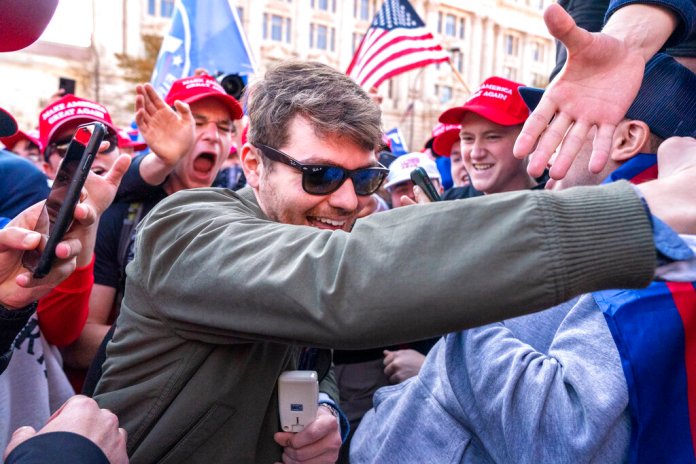
Nick Fuentes, a prominent figure in the white nationalist movement, recently revealed his surprise at the tone of an interview with Tucker Carlson. He anticipated a far more challenging confrontation regarding accusations of antisemitism, even admitting he “almost wanted” Carlson to press him on the issue.
Fuentes described the encounter with Carlson as unexpectedly cordial, noting the conservative commentator refrained from directly labeling him an antisemite. This contrasted sharply with Fuentes’s perception that Carlson later characterized him as such in other public statements, leading Fuentes to feel Carlson was being “two-faced.”
Carlson’s decision to interview Fuentes in late October ignited a firestorm of debate within Republican circles. While some vehemently condemned the platforming of a known white nationalist, others, including former President Donald Trump, defended Carlson’s right to interview anyone he chose. The video garnered an impressive 6.7 million views on YouTube.
The fallout from the Carlson interview extended beyond public discourse, triggering internal conflict within the Heritage Foundation. A defense of Carlson by the organization’s president sparked rebellion, ultimately leading to the resignation or departure of a board member and several employees.
A subsequent interview with Piers Morgan presented a starkly different dynamic. Morgan directly confronted Fuentes with his own past statements, forcing him to defend deeply controversial views. The interview reached a peak of 117,000 viewers, captivated by the unfolding exchange.
Fuentes readily admitted to being racist and expressed a desire to avoid living near Black people. He also shockingly defended Adolf Hitler, calling him “cool” – a statement Morgan immediately challenged by presenting the story of a Holocaust survivor.
Fuentes’s reaction to the survivor’s story was chillingly indifferent. He dismissed the man, questioning his relevance and sarcastically repeating a phrase about his mother being killed by Hitler, highlighting a disturbing lack of empathy.
Recognizing the power of carefully edited clips, Fuentes quickly identified a particularly damning moment as potential viral content. He scoffed at Morgan’s attempt to frame Hitler as a “monster,” revealing a calculated awareness of how his words would be perceived and disseminated.
The conversation extended to other contentious topics, including women’s rights. Fuentes advocated for the abolition of the 19th Amendment, arguing women should remain in the home, a position Morgan labeled as the “purest definition” of misogyny.
Beyond his social views, Fuentes offered a cynical assessment of the Republican Party. He expressed disappointment with the Trump administration and suggested Vice President JD Vance was being strategically positioned as Trump’s successor, backed by wealthy donors.
Fuentes further claimed Vance’s supporters harbored racist sentiments, finding irony in Vance’s public disavowal of racism. He displayed little regret for his past remarks, embracing his role as a provocateur and declaring his willingness to be “very provocative.”
The interviews, particularly the one with Morgan, served as a stark illustration of Fuentes’s unwavering commitment to his extremist ideology and his calculated approach to garnering attention and influence.