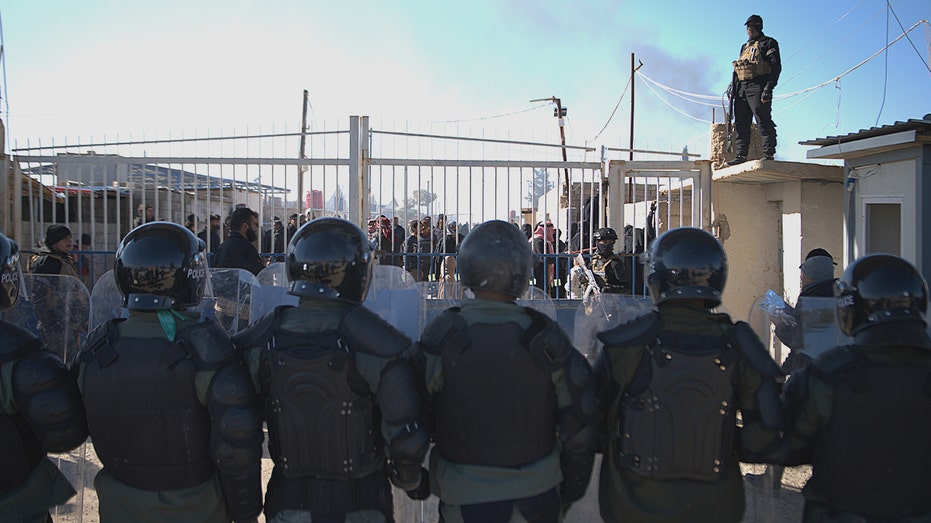
The dust hasn’t settled after the January 19th prison break in northeastern Syria, and a chilling reality is emerging: some ISIS fighters remain unaccounted for. The initial chaos following the escape rendered any comprehensive tracking effort “impossible,” according to an analyst intimately familiar with the situation.
While Damascus claims a majority of the escapees have been recaptured, a significant number remain at large, their whereabouts unknown. The exact figure is obscured by the turmoil that erupted during clashes between Syrian government forces and the Kurdish-led Syrian Democratic Forces, creating a dangerous security vacuum.
Simultaneously, the United States is enacting an emergency plan, transferring thousands of male ISIS militants to Iraqi-controlled facilities. This large-scale operation aims to prevent a resurgence of the terror group amidst the deteriorating security landscape in Syria.
The transfers, already underway with roughly 150 fighters moved to secure locations in Iraq, could ultimately involve as many as 7,000 detainees. Iraqi authorities have already received an initial group of 144, with further airlifts planned to bolster security.
This rapid relocation is driven by the urgent need to contain the threat, as Iraq’s prisons are considered more secure against mass breakouts. The move acknowledges the instability in northeast Syria and the limitations of current detention facilities.
However, this solution addresses only half the equation. The transfers specifically target male fighters held in prisons, leaving a vulnerable population behind: the wives and children of ISIS members. These individuals remain in Syrian detention camps, under the control of Damascus.
These camps, like the infamous al-Hol, house tens of thousands of ISIS-affiliated women and children, a complex humanitarian and security challenge. Unlike the male fighters, they are not held in traditional prisons and are subject to a different set of procedures.
The long-term solution for this population lies in repatriation to their home countries, a process hampered by widespread reluctance from governments worldwide. Determining which women remain ideologically committed and which are simply victims of circumstance requires careful, individual assessments – assessments that have yet to be conducted on a large scale.
The entire detention system, even before the recent events, was fundamentally fragile. It was chronically underfunded and always intended as a temporary measure, awaiting a lasting resolution. The transfers to Iraq offer a short-term fix, but the core problem remains unresolved.
A shift in responsibility is also occurring, with the U.S. Special Envoy for Syria noting that the Syrian Democratic Forces’ role as the primary anti-ISIS force is diminishing. Damascus is now both capable and willing to assume security responsibilities, including control of detention facilities and camps.